


Rigid companies break during a crisis, but adaptable ones thrive. When the market gets rocky, smart entrepreneurs know exactly when to shift gears. Sometimes, surviving an unpredictable economy means bringing in a fresh investor to boost your cash flow. Other times, it means buying out a business partner who wants to exit during a crisis.
But when flights are limited, or the market is volatile, add or remove a UAE company shareholder in the middle of a crisis?
Yes. Changing your UAE company structure is no longer the bureaucratic nightmare it used to be. Thanks to the country’s massive push for digital government services, you can legally add or remove a UAE company shareholder without ever setting foot inside an office. However, while the legal transfer is highly efficient, dealing with the banks and tax authorities requires a very careful approach. If you want to explore different restructuring scenarios right away, browse our complete library of UAE share transfer guides.
Key Takeaways for Changing Shareholders:
- Fully Digital Process: You can sign share transfer agreements remotely using a virtual Power of Attorney (POA) and your UAE Pass.
- Mutual Consent is Mandatory: You cannot kick out a shareholder from the business; they should agree to sell or transfer their shares.
- The Banking Catch: Updating the company’s record with the bank is a no-feat. The challenge is to secure the bank’s approval despite the change in ownership structure without freezing the account.
- Tax Updates: Any change in the company’s structure should be relayed to the Federal Tax Authority (FTA) by updating the company’s details in the FTA portal and uploading the related document.
Why Add or Remove a UAE Company Shareholder During a Crisis?
Uncertain times force you to make tough calls. When regional or global disruptions hit, we typically see entrepreneurs restructure their companies to solve one of these three problems:
- Capital Injection: Bringing a new investor on board and handing over some equity is sometimes the only way to keep the business afloat.
- Managing a Partner’s Exit: Money problems will test any partnership. If a co-founder gets nervous and wants out, buying up their shares is usually the cleanest way to shield the company from an internal problem.
- Merger to Save Cost: If you are running multiple small branches, it often makes financial sense to merge them. Rolling those local shares into one central holding company is a brilliant way to slash your overhead costs.
The New 2026 Corporate Rules
If you are looking to restructure, you are doing it at the perfect time. The UAE recently rolled out a major overhaul to the Commercial Companies Law (Federal Decree-Law No. 20 of 2025), which officially took effect earlier this year. (Note: Existing companies have until June 30, 2026, to update their corporate documents to match these new rules).
Here is how this new law makes adding or removing a UAE company shareholder easier:
- Multiple Share Classes: In the past, all shares in a standard Mainland LLC held equal weight. Now, companies can issue different classes of shares, i.e., “Class A” or “Class B”. This means you can bring in a silent investor for a cash injection and grant them dividend rights, while you retain 100% voting control.
- Trade Assets for Shares: Don’t have cash? The new rules allow “in-kind” capital contributions. A new partner can now legally trade assets—like intellectual property, equipment, or real estate—in exchange for company shares.
- Priority Rights to Existing Partners: The 2025 Law reinforces the Right of First Refusal, ensuring that if a shareholder decides to exit, they must first offer their shares to the remaining partners before approaching an outsider. This statutory protection acts as a built-in safety net, preventing unwanted third parties from entering your business without your consent and keeping control exactly where it belongs.
- Drag-Along & Tag-Along Rights: If the majority owners want to sell the company during a crisis, they can now legally “drag” a stubborn minority shareholder into the deal. As a minority partner, you can use these “tag-along” rights to piggyback on their deal, guaranteeing you get the exact same buyout terms.
- Corporate Migration: Want to move your company from a Free Zone into the Mainland to tap into the local market? You can now seamlessly “re-domicile” your company without dissolving it and starting over.
Please stand by for our upcoming article on this, entitled “The 2026 Hybrid Model: How Free Zone Companies Can Trade in Dubai Mainland.”
How the 2026 Corporate Laws Changed Share Transfers
| Feature | Old Way (Before 2026) | The New 2026 Reality | Why It Matters |
| Classes of Shares | All LLC shares held equal voting and dividend weight. | You can issue different classes of shares (e.g., Class A, Class B). | You can bring in a “silent investor” for cash without giving up your voting control. |
| Buying Out Partners | A stubborn minority partner could easily block a company sale. | “Drag-along” and “Tag-along” rights are now legally recognized. | You can legally force a minority partner to sell if the majority agrees it’s best for the business. |
| Capital Contributions | You generally had to inject hard cash to get new shares. | “In-kind” contributions are allowed (trading assets for shares). | You can fund your business growth by trading shares for intellectual property, real estate, or equipment. |
| Signing the Deal | Required booking a flight for an in-person notary appointment. | Fully remote using secure video-link Power of Attorney (POA) and UAE Pass. | You can execute the entire restructure remotely. |
How to Transfer UAE Shares Remotely (The 2026 Way)
A few years ago, transferring shares meant all partners had to sit down together with a notary. Today, the UAE has digitalized the entire process.
Whether your company is registered in the Dubai mainland with the Department of Economy and Tourism (DET) or in a Free Zone, the actual share transfer can happen online. (Operating outside of Dubai? Keep an eye out for our upcoming blog: Managing Share Transfer in Abu Dhabi Mainland Companies: A Step-by-Step Guide!) You need to draft and sign a Share Transfer Agreement; in mainland jurisdictions, it must be notarized. A fully signed and ink-stamped agreement is acceptable for the free zone.
If you are out of the country and your company is registered in a mainland jurisdiction such as Dubai or Abu Dhabi, you can grant a Corporate Service Provider (CSP), such as CorpLex, a remote Power of Attorney via video call. We then act as your legal stand-in to process the paperwork locally, e.g., the signing of the amended Memorandum of Association. On the other hand, most free zone authorities process the UAE share transfer directly with you by sending you a link to e-sign the amended corporate document, as your specimen signature has long been saved in their system.
Removing a Shareholder: Can You Force an Exit?
This is where things get tricky during “uncertain times.” If a partner is no longer aligned with the company’s vision, removal usually happens in one of two ways:
- Amicable Exit: The partner sells their shares back to the company or to other partners via a standard transfer by signing an agreement to that effect.
- Litigation: If there is a dispute, you cannot simply “delete” a partner. Recent 2026 rulings confirm that LLC partner removals require specific court triggers under the Companies Law, not just general civil grievances.
The Compliance Challenges: Banks and Taxes
Updating your trade license to show a new owner usually takes just a few days. The real challenge lies with informing the bank’s compliance team and the tax authority about the change in the ownership structure. Here are the reasons why:
1. Corporate Bank Account Freezes
Financial institutions do not handle sudden changes in ownership well. As soon as you tweak your trade license, your corporate bank will immediately launch a new corporate bank account KYC audit. If you miss their strict paperwork deadlines, you’ll quickly find yourself locked out of your own business accounts. You need a reliable Corporate Services Provider to clear these documents before finalizing the share transfer.
2. FTA and Corporate Tax Updates
The Federal Tax Authority (FTA) no longer waits for your annual filings; its systems track corporate changes the moment they occur. Changing the business owners means changing how the business gets taxed. If you wait around to update your EmaraTax portal after a major restructure, you’ll be hit with serious fines before you know it.
Stop Waiting for the Perfect Timing
Volatile markets are simply a reality of modern business. If your current ownership structure isn’t working, holding out for a quieter economy before making a move is one of the biggest risks you can take. Using the new 2026 tools gives you the flexibility to adapt immediately and keep your company secure.
This article is written by the local experts at CorpLex. At our core, we are more than advisors; we are Architects of Success, seamlessly combining legal expertise with business advisory excellence. Running a business is hard enough without having to decode UAE corporate laws, DET updates, and FTA tax requirements. If you need to navigate a messy share transfer from overseas or just want a local team to take over the daily compliance headaches, that is exactly what we do. CorpLex is here to ensure that the share transfer is done perfectly.
How Does the Share Transfer Process Actually Look Like
You should not waste time trying to figure out where to submit the request and how to handle the UAE company share transfer process. We handle the actual groundwork for you:
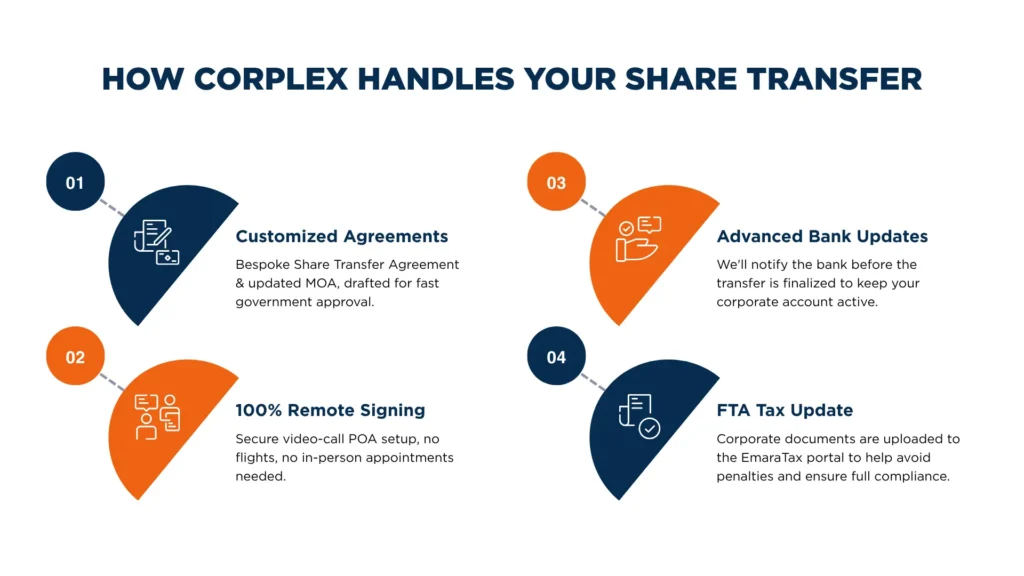
- Customized Agreements: Instead of using generic templates, we write up a Share Transfer Agreement and an updated MOA that match what you and your partners agreed. As we spent years dealing directly with the local government, we know exactly how to draft these contracts, so they are approved without any back-and-forth delays.
- 100% Remote Signing: Nobody needs to fly into the UAE and sign papers. We organize secure video calls to get your Power of Attorney approved so your partners can sign from wherever they are.
- Advanced Bank Updates: We will work with the bank closely to inform them of the ownership change before the transfer is finalized. This will prevent freezing of the corporate bank account.
- Update to the FTA: We will update your company’s details in the EmaraTax portal by attaching the corporate documents (the license and Memorandum of Association) to avoid penalties.
Need to add or remove a UAE company shareholder to navigate a crisis quickly?
Let CorpLex assist you in completing the share transfer process. Reach out to us today!
Frequently Asked Questions (FAQs)
-
Can I remove a UAE company shareholder without their consent?
No, this isn’t possible. Every shareholder legally owns a specific portion of the business, which means they must agree to surrender or sell their shares. For the removal to be valid, a signed agreement or a direct court order is necessary.
-
Do I need to be in the UAE to sell my shares?
No. You can legally execute the sale from abroad by issuing a remote Power of Attorney to our team via a secure video call if you have a mainland company. On the other hand, free zone authorities facilitate the transfer of shares through online processing or e-signing, so you can handle this by yourself, remotely.
-
How long does a share transfer take?
The government side (updating the actual trade license) usually takes 1 to 3 weeks in Dubai mainland and most Dubai-based free zones. Share transfer in Abu Dhabi mainland companies, however, follows a different timeline of around 4-6 weeks. Updating your corporate bank account can take several weeks, depending on the new shareholder’s background checks.
-
What happens to a partner’s UAE residency visa if they sell all their shares?
Once a partner is officially removed from the trade license, their associated investor visa must be cancelled or downgraded to a standard employment visa. If they are leaving the business entirely, they will have a standard grace period to secure a new visa before facing any overstay fines.
-
Can I leave the company if it has outstanding business debts?
Yes, but you can’t just walk away in secret. The incoming shareholder must formally agree to assume the liabilities associated with those shares. Also, if your business has an active corporate bank loan, the bank usually needs to approve any change in ownership before the change takes effect. Trying to quietly jump ship to avoid company debt is the fastest way to get your corporate accounts completely frozen.