



A lot of business owners make the same mistake. They stop trading, stop answering emails, and quietly board a flight home — fully convinced that walking away is the same as closing it down. In the UAE, it isn’t. An inactive UAE company that hasn’t been properly wound down or frozen is still a live legal entity, and the bills it runs up don’t care whether you’re in Dubai or three time zones away.
Fines stack. Tax deadlines come and go. And in the worst cases, the consequences stop being a company problem and start being a personal one.
Key Takeaways
An inactive UAE company that isn’t formally closed or frozen will keep generating fines, mandatory tax filings, and for owners who leave visa quotas untouched, the very real risk of being blacklisted. The fix is straightforward: either shut the business down properly or apply to freeze the licence while keeping up with basic FTA requirements.
What does “Inactive UAE Company” Actually Mean Here?
An inactive UAE company is one that’s stopped trading, has no revenue coming in, and shows a flatline on its bank statements. Most owners assume that nothing happening means nothing owed. That’s the part that catches people off guard.
Even an expired licence doesn’t dissolve a company’s legal obligations. Until you formally liquidate or freeze, the authorities treat it as active and they enforce it accordingly. Dealing with that reality upfront is almost always cheaper than dealing with the fallout later.
.
Why Some UAE Businesses Go Inactive in 2026?
Regional tensions, disrupted trade routes, and the general unpredictability of the past couple of years have led many entrepreneurs to hit pause. That decision often makes sense. What doesn’t make sense is pausing the operations but leaving the compliance side completely unattended.
What The Fines Actually Look Like?
Ignoring an inactive UAE company is a costly strategy. The Department of Economy & Tourism (DET) and most Free Zone authorities aren’t passive about non-compliance. Inactive companies get chased, not filed away.
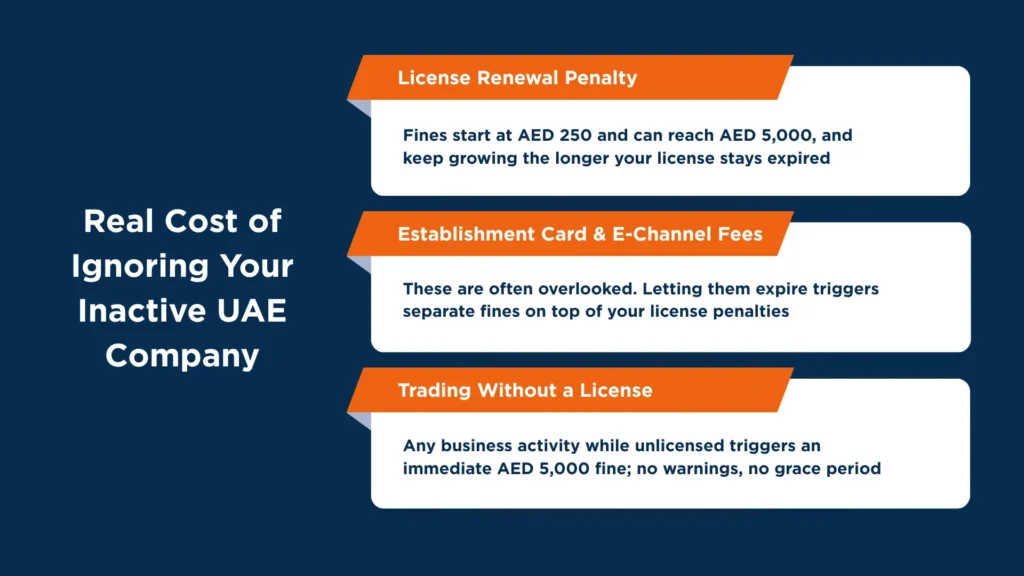
- License Renewal Penalties: Non-renewal fines start at AED 250 and can climb to AED 5,000, and they keep building the longer the license sits expired.
- Establishment Card and E-Channel Fees: Separate fines apply for letting these lapse, too. They’re easy to forget and expensive to ignore.
- Trading Without a License: Any business activity while unlicensed triggers an immediate AED 5,000 penalty, with no grace period.
The Tax Obligations That Don’t Go Away
This is where owners get blindsided. Holding a trade license — active, expired, or otherwise puts your company inside the UAE’s Corporate Tax framework, regardless of whether it earned a single dirham.
- Zero Returns: The Federal Tax Authority (FTA) still requires a nil return confirming no activity. Not filing it costs AED 10,000.
- VAT Deregistration: If the company was VAT-registered, missing the deregistration window adds AED 1,000 for every month you’re late.
These aren’t obscure technicalities. They’re standard enforcement, and the FTA applies them consistently.
MoHRE’s Crackdown on “Paper-Only” Staff
If your company went dormant but the visa quota stayed open, you have a separate problem. The Ministry of Human Resources and Emiratisation (MoHRE) treats sponsored visas tied to non-trading companies as “fake hiring,” and their enforcement over the past two years has been serious.
- Companies caught have faced combined penalties north of AED 34 million.
- Owners don’t just pay fines. They get blacklisted from registering any future business in the UAE.
- Sponsored visas linked to a dormant company can trigger individual penalties of up to AED 20,000 once the system flags them.
When the LLC Stops Protecting You?
The general rule for a limited liability company is that your personal assets remain separate from the company’s debts. That holds — right up until it doesn’t.
- UAE courts have a “gross error” clause that allows judges to hold owners and managers personally liable when abandoning a company amounts to a clear failure of duty. In practical terms:
- Unpaid company debts over AED 10,000 can result in a personal travel ban for managers, owners, and bank signatories.
- Courts in Dubai and Ras Al Khaimah have recently held managers personally liable for governance failures in companies left to go dark.
The LLC shield is real, but it has edges.
What the 2025 Law Change Opened Up?
Federal Decree-Law No. 20 of 2025 came into force on October 15, 2025, amending the UAE’s Commercial Companies Law. For business owners sitting on an inactive company, the reforms introduced some genuinely useful tools — not all of them exit routes, but all of them worth knowing.
New Tools Under the 2025 Commercial Companies Law
| Option | What It Does | Best For |
| Voluntary Liquidation | Formally closes the company with full debt settlement | Solvent companies ready for a clean, permanent exit |
| Re-Domiciliation | Moves your company’s registration to a different authority or emirate — no dissolution required. | Companies relocating between jurisdictions, not closing |
| Share Transfer | Drag-along and tag-along rights now codified in law, making exits via sale cleaner and more enforceable | Owners looking to sell rather than shut down |
| Multi-Class Shares | LLCs can now issue share classes with different liquidation priorities, locking in who gets paid first on closure. | Companies with multiple investors or staged capital structures. |
A separate note on license freezing: this is not part of the 2025 law changes. Freezing a trade license is a DET and Free Zone administrative tool that has existed independently for years, allowing dormant companies to pause obligations for up to three years. It remains one of the most practical options for inactive businesses — it just sits outside this legislation.
Weighing a temporary pause against a permanent closure? Read: “2026 Strategy: Should You Freeze or Liquidate Your UAE Business?”
How CorpLex Comes In?
CorpLex handles the process from start to finish — useful when you’re managing this from abroad or don’t want to navigate it alone:
- Liquidation: Full cycle management, from initial application through final deregistration.
- License Freezing: Direct experience with Department of Economy & Tourism and Free Zone applications. See our “Strategic Guide to Freezing Your UAE Business License“ for the full breakdown.
- Tax Filings: Zero Returns filed, VAT deregistration handled, FTA penalties avoided.
- Visa Cancellations: Every sponsored visa was cancelled on time and by the book.
Where Things Stand
Leaving an inactive UAE company to sit without a plan is, consistently, the most expensive option on the table. The fines are real, the tax exposure is real, and for some owners, the personal liability is real too.
Reach out to Corplex today for a straightforward conversation about your options.
Frequently Asked Questions (FAQs)
-
Can I just leave my company in the UAE and fly home?
No. Running away from the UAE does not close your company. Fines will continue to pile up, and you may face a travel ban or be blacklisted from registering future business in the UAE.
-
Does an LLC protect my personal bank account from company fines?
Generally, yes. However, if a court finds you committed a “gross error” or fraud, it can “pierce the corporate veil” and hold you personally liable.
-
How long can I freeze my trade license in Dubai?
Most jurisdictions, including the Dubai DET, allow you to freeze a license for up to three years.
-
Do I need to file taxes if my company has made zero profit?
Yes. You must file a “Zero Return” for Corporate Tax to stay compliant with the Federal Tax Authority (FTA).
-
What is the penalty for “fake hiring” in an inactive company?
In the 2025-2026 crackdown, companies have faced collective fines exceeding AED 34 million, and managers can be referred for criminal prosecution.