 English

 5.0verified by TrustindexTrustindex verifies that the company has a review score above 4.5, based on reviews collected on Google over the past 12 months, qualifying it to receive the Top Rated Certificate.
Dubai Free Zone is a designated economic area where a business is registered under a specific Free Zone Authority, outside mainland UAE commercial law. It’s the backbone of the emirate’s foreign investment strategy. Dubai has over 26-28 free zones (a total of 40 accross UAE), each built around approved commercial activities, and licences are issued only for those categories.
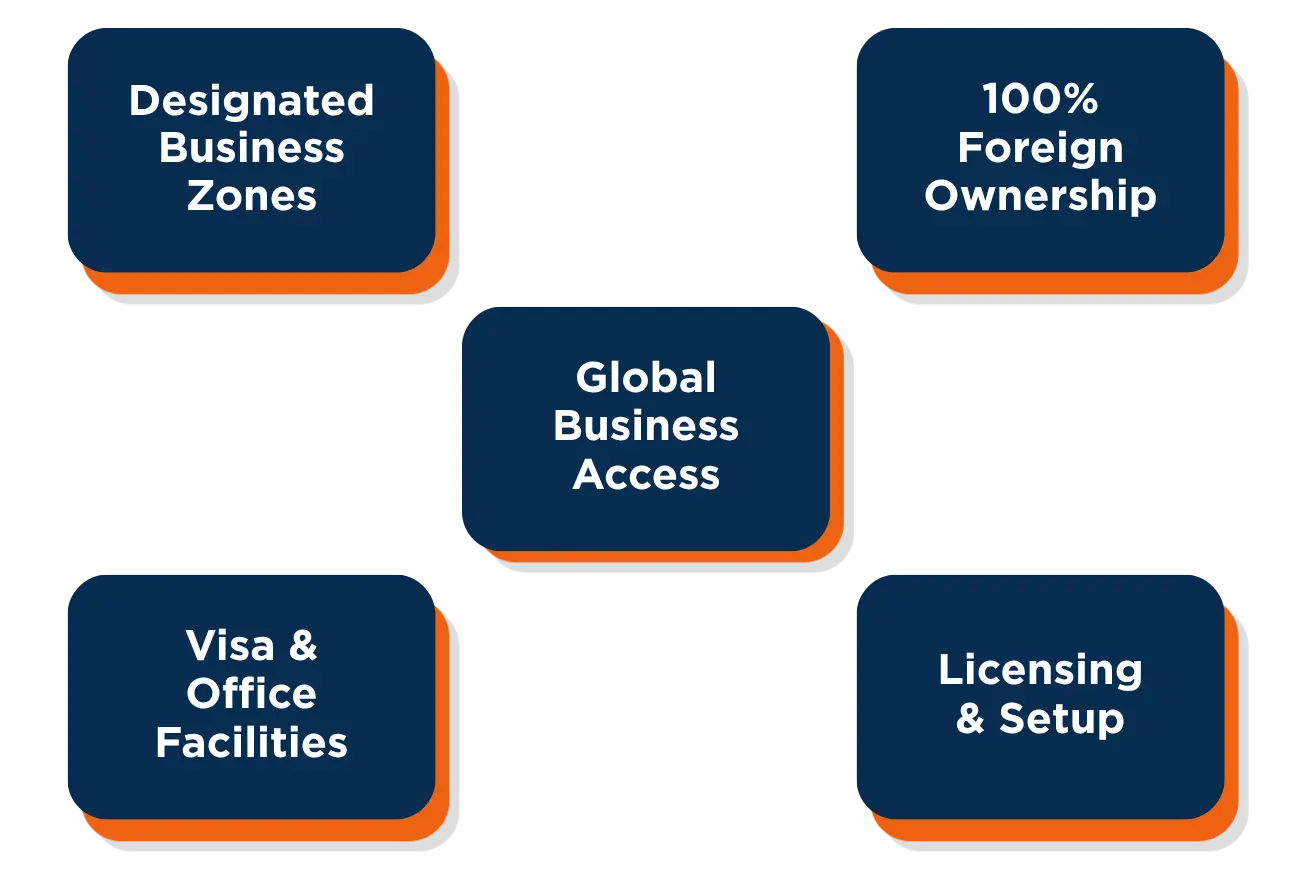
Free zones attract foreign investors by offering 100% ownership, minimal taxes, full profit repatriation, customs exemptions, faster setup, visas, offices, and streamlined global business access.
They can operate in the designated area within the UAE and globally, but direct local or mainland trading requires additional licensing, a local distributor, or a mainland branch through the DED/DET. See our Free Zones vs Mainland guide for details.
Free zones allow full foreign ownership without a UAE national sponsor, giving investors complete legal control.
Companies pay minimal corporate tax, no personal taxes, and investors can transfer all profits and capital abroad anytime without restrictions.
Centralized service centres handle licensing, registration, and approvals, allowing many businesses to complete setup within a week.
Each free zone is built around defined sectors like finance, technology, logistics, or media, creating ecosystems that support partnerships and growth.
Free Zones let businesses start with virtual offices. You can pick visa packages tied to your office size and company needs.
Choose a structure based on the number of owners and whether you are launching a new brand or extending an existing one.

A company formed by one shareholder, either an individual or corporate entity, with full ownership and responsibility under the Free Zone Authority.
A company registered with two or more shareholders, allowing shared ownership, defined liability, and compliance under the zone’s regulations.
An extension of an existing company, operating in Dubai while remaining legally dependent on the parent entity and subject to its corporate framework.
Dubai free zones offer different types of business licenses depending on your intended activity:

Establish your company in the region’s premier financial hub under English Common Law, hosting banks, asset managers, fintech firms, and top law offices.

Join the world’s top commodities and crypto hub in JLT, home to trading leaders in gold, diamonds, tea, energy, and blockchain enterprises.

A specialized district focused on logistics, aviation, e-commerce, and supply chain businesses, leveraging proximity to Al Maktoum International Airport.

Connect with the Middle East’s largest ICT hub, hosting regional headquarters for Microsoft, Google, Oracle, IBM, and a broad range of technology/digital services.

Position your brand in a creative ecosystem for fashion, design, luxury, and architecture, alongside luxury brand companies such as Burberry & Vogue.

Leverage one of the world’s largest industrial hubs, with direct port access and infrastructure for logistics, trading, and high-volume industrial operations.

Build your tech startup or R&D business in a modern technology park with semiconductor, electronics, and digital innovation facilities alongside IT companies.

Access cost-effective, flexible licensing for SMEs, professional services, and digital entrepreneurs, with streamlined registration and virtual office options for fast setup.
Choosing the right free zone means aligning your business goals, budget, office needs, and future growth with the zone’s strengths.

Choose Your Free Zone:
Pick a zone that matches your industry and growth goals.
Select Business Activity:
Decide the general type of approved work your company will do.
Register Trade Name:
Reserve a name that fits your business and zone guidelines.
Obtain Business License:
Obtain the appropriate license based on your activity and company structure.
Visa & Office Setup:
Arrange visas for owners and employees and choose flexible workspace options.
Dubai Free Zones tie your visa allocation to office type and size. Choose space based on team size, operational needs, and growth plans:
Note! In Free Zones, you can keep renewing flexi-desk or virtual offices each year, while the Dubai Mainland usually requires upgrading to a physical office after the first year.
Dubai Free Zone setup costs vary by license, office type, visas, and additional government and service fees.
You can run into costly delays and complex issues during Free Zone setup, from banking hurdles to strict compliance requirements. Get expert help with CorpLex. We offer:
Reach out to us for expert guidance to ensure correct licenses, visas, and tax compliance.
Posted on Google Daler DehqonovAugust 19, 2026
Trustindex verifies that the original source of the review is Google.
We set up our company with Corplex one year ago, and the team has been truly professional, responsive, and friendly from day one. They have answered all our questions throughout the year and have also supported us with all corporate matters. Recently, they also handled the compliance request with the authority and finalized everything very quickly, while guiding us properly throughout the entire process. What we really appreciate about Corplex is that they provide end-to-end services, from company formation to visa processing corporate bank account opening, as well as tax and accounting services. A special thanks to our consultant, Rana, who has supported us endlessly and has always been available whenever we needed assistance. We would also like to thank Maylyn, Zavokhir, Nissa and the entire team for handling all our company operations so professionally. A truly reliable company with an excellent team. Highly recommended!Posted on Google Elyor Rasul-zadaAugust 14, 2026I would like to express my sincere appreciation for the excellent service and support provided throughout the visa renewal process. The entire team was very professional, responsive, and attentive at every stage. I especially appreciate how quickly you responded to our requests, kept us informed, and did your best to make the process as smooth and efficient as possible. A special thank you to Rana and the PRO team for their professionalism, patience, and dedication. Despite some unexpected challenges during the process, everything was handled in a very organized and professional manner. Thank you once again for your outstanding service and support. It was a pleasure working with your team, and I would be happy to recommend your services to others.Posted on Google
 Deepak TalwarAugust 7, 2026Posted on Google
 РусланаJuly 24, 2026I had a great experience with this company. They helped me get my visa process done so quickly and smoothly. Everything was hassle-free. Highly recommend!Posted on Google
 Helen AreguyJune 28, 2026⭐⭐⭐⭐⭐ I had a fantastic experience with CorpLex Corporate Services. They made the process of setting up my business in Dubai incredibly smooth and stress-free from start to finish. The team took the time to understand my requirements, answered all of my questions, and provided clear guidance throughout the entire process. They also introduced me to additional services that will be valuable as my business grows, including corporate tax and VAT support. Everyone was professional, friendly, and genuinely committed to making the experience as seamless as possible. I was referred to CorpLex, and I’m very grateful for the recommendation. I look forward to building a long-term partnership with the team. Thank you to everyone at CorpLex Corporate Services for your exceptional support and for making the entire process so easy. I highly recommend your services to anyone looking to establish a business in the UAE.Posted on Google
 CLAUDIO CONTIJune 26, 2026Excellent work from team of Abbosand Janine , in order of corporate tax ,very professional and knowledge of a very complex subjectPosted on Google
 Amer BinEshaqMay 21, 2026I would like to thank the team from Corplex. Especially: Rana, Ahmed & Saba. They respond very quickly, professional, and supportive. I would like to thank them also for providing clear and timely guidance. Their attention to detail, dedication, and positive attitude make working with Corplex is a real pleasure. Thank you for your outstanding support!Posted on Google
 Victoria AbeltinoApril 28, 2026I had the opportunity to intern at Corplex for 4 months and it was an incredible rewarding experience. During my time there, I learned a lot about the legal side of running a company, especially aspects related to corporate law. The internship was very well organized, and I always felt supported and guided throughout the experience. The team was extremely kind, attentive, and made sure I was actively involved, which made the experience both enjoyable and highly educational. I would also like to thank Rana Amine for their guidance and support throughout my internship. It was an incredibly valuable experience, and I genuinely loved working there.Posted on Google
 Rizwan ArshadApril 16, 2026CorpLex helped me renew my visa and setup a new company. They provided a fast and professional service keeping me informed at every stage of the process.Posted on Google
 Alisher AbdullaevApril 16, 2026Very dedicated team of professionals who will never give up for the sake of the clients’ interests 🔥
Dubai free zones are designated economic areas offering sector-specific licenses, benefits, tax incentives, and simplified business regulations based on common law.
Free zones offer ownership and tax advantages but limit local trade, while mainland companies trade across the UAE markets.
You may operate internationally or within the free zone only; mainland activity requires a separate UAE onshore company.
It usually takes two to five business days when documents and approvals are complete.
Yes, freezone companies can now enter mainland markets by opening licensed branches under updated rules.
WhatsApp us
