



Key Takeaways: Finding the Right Path
- The Big Decision: You’re essentially caught between maintaining an expensive, quiet company or facing the messy, permanent task of shutting it down for good.
- License Freezing: This is a legal way of putting your business “on hold”. You stop daily costs immediately while keeping your brand and trade license “on ice” so you can restart later.
- Company Liquidation: This is the clean break. This requires you to settle all debts, disconnect utilities, and permanently cancel all visas.
- The Visa Factor: No matter which path you take, you must cancel all company-sponsored visas to clear your immigration file.
- The Tax Trap: In the end, you must bear in mind that whichever option you choose, your responsibility for tax compliance remains. Missing your VAT deregistration window is the easiest way to lose AED 10,000 in penalties.
Nobody starts a company expecting to shut it down. But in 2026, many founders are forced to decide whether to freeze or liquidate your UAE business due to rising costs and market uncertainty. If you’re looking at your monthly expenses, watching your cash reserves get depleted, and wondering how to stop the financial drain, you’re not alone. Many founders are currently facing the difficult decision about the future of their businesses.
When it comes to cutting your losses and protecting your capital, understanding the differences between UAE License Freezing vs Liquidation is the single most crucial step you can take.
Let’s be real: whether you are just shifting your focus to wait out the current market turbulence, or you are completely done and ready to exit, you cannot just abandon a trade license. Ignoring it is an expensive mistake. The compounding government renewal fines, mandatory lease agreements, and strict tax compliance rules will burn through your remaining capital faster than you might expect.
Curious about the actual penalties of doing nothing? Watch out for our upcoming blog, so keep an eye out for that: What Happens if a UAE Company Becomes Inactive?
The real question is deciding which route stops the financial bleeding for your specific setup. Here is the reality of pausing your operations compared to a total shutdown.
Freeze or Liquidate Your UAE Business: Understanding Your Options
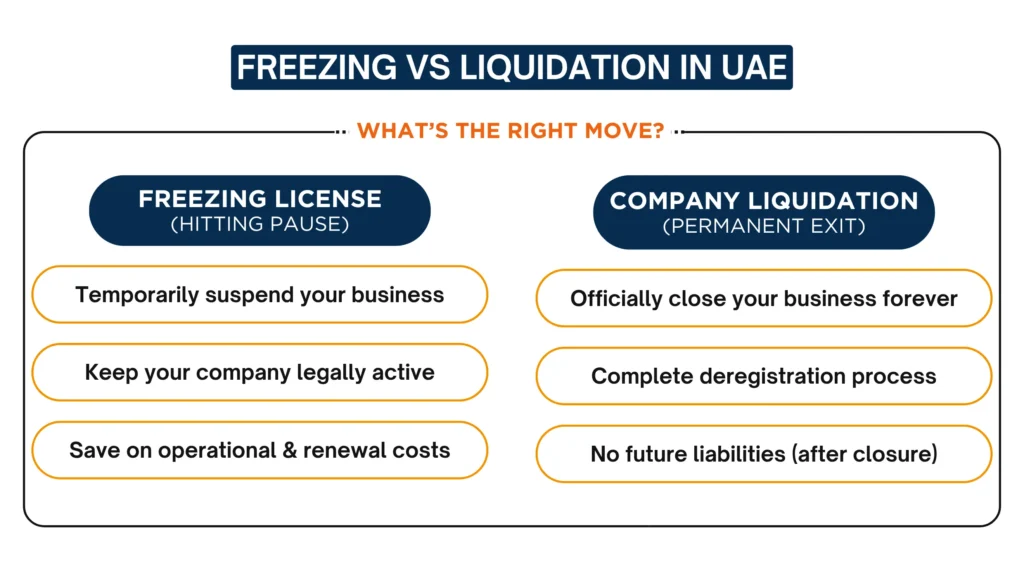
Option 1: Freezing License (“Hitting Pause”)
- The Goal: You aren’t closing the company; you are just putting it into a legally recognized sleep mode and reopening it in the future. The government temporarily marks your trade license as inactive. This protects your brand and saves you from the operational costs.
- The Strategy: This keeps the company alive without the heavy financial burden of daily operations and annual renewals. It is not a cancellation but rather a legal pause or a temporary cessation of business.
- The Catch: You need to genuinely stop. Every single business activity must come to a halt. You cannot invoice, trade, or continue operating under the radar.
Want a deep dive to know which authorities offer this option? Check out our complete Strategic Guide to Freezing Your UAE Business License.
Option 2: Company Liquidation (The “Permanent Exit”)
Whether your designated free zone or mainland authority refers to it as “deregistration” or a “strike-off,” liquidation constitutes the formal procedure for permanently ending business operations. Under Federal Decree-Law No. 20 of 2025, shutting down your business for good involves strict procedures to ensure every loose end is tied up.
- The Goal: Walking away without turning back. You are aiming for a totally clean break. You need to ensure you close your business by appointing a liquidator, paying off debts, closing bank accounts, and getting clearances from utility companies.
- The 45-Day Rule: But here is the silver lining. If your business is experiencing some setbacks, don’t rush straight to the liquidation finish line. The updated UAE Bankruptcy Law offers a “preventive settlement” option. Think of it as a court-approved timeout. Instead of forcing you into a permanent shutdown, this route lets you keep the doors open and the revenue flowing. At the same time, you officially sit down with your creditors to renegotiate and save the company.
- A Warning on Liability: Be careful, as the new laws have expanded the personal liability of managers and directors. If a company fails due to gross negligence within two years of bankruptcy, courts can now compel management to pay those debts personally.
- The Result: Once the Final Liquidation Certificate is issued, the company is gone forever. If you want to do business in the UAE again, you’ll have to begin anew.
PRO Tip for 2026: Do not just let your license expire and walk away. Fines for non-renewal will continue to pile up until a formal liquidation is completed. If you just want to move your business from a Free Zone to the Mainland, new “Company Mobility” rules may now allow you to migrate your legal seat without needing to liquidate at all.
An upcoming blog will be published soon about “How Free Zone Companies Can Trade in Dubai Mainland”. Keep checking for updates.
The First Hurdle: Clearing MoHRE and Employee Visas
This is likely the toughest part of the entire process. Having to sit down with your team and explain that you’re cancelling visas and letting everyone go is a heavy conversation, but legally, there is no way around it. The UAE government will not approve a license freeze or a liquidation while there are still active visas, open labour contracts, or unpaid salaries tied to the company.
This requirement applies to every single employee and other visas, such as an investor or partner visa. This means paying out final settlements, clearing your records with the Wage Protection System (WPS), and securing a final clearance from the Ministry of Human Resources and Emiratisation (MoHRE) or your Free Zone authority. Make no mistake: if your WPS dashboard shows pending salaries, license freezing, or a liquidation application will be blocked at the very first step.
Don’t Ghost Your Bank
A massive mistake founders make is assuming they can withdraw their remaining cash, leave the corporate bank account sitting at zero, and walk away.
With UAE banking compliance tighter than ever, ghosting your bank is a dangerous move. If you abandon an account, the bank’s automated compliance systems will eventually flag the inactivity and your expired trade license. This can lead to a compliance blacklist, making it incredibly difficult to ever open another corporate account in the Emirates. Moreover, monthly banking service charges or “fall below the avarage balance” fees continue accumulating.
To do this by the book, you must formally shut down the account and secure a “Bank Clearance Letter” or a dormancy certificate. In fact, some major authorities now legally require this official clearance document before they will even process your freeze or liquidation request.
The Compliance Trap: Corporate Tax vs. VAT
Whichever path you choose, the Federal Tax Authority (FTA) is the one entity you cannot ignore. This is where most business owners make a critical, AED 10,000 mistake.
If you liquidate: You must apply for total Corporate Tax and VAT Deregistration. If you fail to formally deregister your tax profile after liquidating, the FTA will continue to expect tax returns, resulting in severe compounding penalties.
If you freeze: The rules are split into two distinct paths for VAT and Corporate Tax:
- Corporate Tax: Whether your license is active or “inactive,” your company must be registered with the Federal Tax Authority (FTA) for corporate tax. The Corporate Tax registration can remain active, provided the annual Corporate Tax return is filed with Nil returns.
- VAT Deregistration: When a business stops generating taxable sales—or drops below the AED 187,500 mark, the clock starts ticking. You have exactly 20 business days to submit your request to cancel your VAT registration to the FTA. If you miss that timeline, they will fine you AED 10,000. You can re-register for VAT later once operations resume.
Which one is cheaper? License Freezing or Liquidation?
When you are already trying to stop the financial bleeding, the last thing you want is a surprise bill. Here is how the costs stack up between the two options:
- The Cost of Freezing (Lower Upfront, Minor Recurring): You will need to pay a standard government freezing fee to your specific licensing authority. While this varies by Free Zone or Mainland jurisdiction, you can generally expect to pay a ballpark of AED 2,000 to AED 3,000 annually. The real financial win here is that you can immediately drop your expensive office lease and stop paying for employee visas and salaries. You’ll still have to pay a small annual fee to maintain the “frozen” status on the registry with your licensing authority.
- The Cost of Liquidating (Higher Upfront, Zero Recurring): This is a much heavier initial blow to your cash flow. Between the liquidator’s fees, newspaper ads, and government deregistration, you’re looking at a total cost ranging from AED 10,000 to AED 25,000+. The final number really depends on your company structure, any late fines you’ve picked up, and whether you are registered in a Free Zone or on the mainland. It stings in the short term, but once that final certificate is in your hands, the financial drain stops permanently. You will never pay another dirham for that company again.
(And don’t forget the hidden trap: whichever route you choose, making a critical mistake like missing your VAT deregistration deadline will hit you with an immediate AED 10,000 government penalty).
The Head-to-Head Comparison
| Feature | License Freezing | Company Liquidation |
| Primary Intent | Temporary pause to protect brand name and company history. | A permanent exit and the full closure of the business. |
| VAT Status | Official cancellation of tax registration prior to expiry of the deadline; if you fail, you will be fined. | Total deregistration required. |
| Corporate Tax Status | Registration remains active; must file Nil returns. | Total deregistration required. |
| Visas | All visas must be cancelled (both employees and partners) to clear the immigration file. New visas can be issued if you reactivate later. | Every single visa tied to the company gets cancelled for good. You can never sponsor anyone under this entity again. |
| Reactivation | Yes. Reactivation is more cost-effective than starting from scratch. | Impossible. Must open a brand-new entity. |
| Estimated Cost | AED 2,000 to AED 3,000 annually, and visa cancellation fees in the first year | One-time cost: AED 10,000 to AED 25,000+ additional fees for liquidator’s appointment, visa cancellations, clearance letters from banks and utilities, newspaper ads, etc. |
How CorpLex Can Help You Decide
Deciding on a path is only half the battle; the other half is the paperwork. At CorpLex, we examine your business’s current situation alongside its long-term goals to map out the best strategy ahead.
- For license freezing: Everything can be done remotely. How? We take over the administrative process via Power of Attorney, managing it and keeping your tax files compliant while the company is on standby.
- For liquidation: We step in as your official liquidator and wind down your business. We take care of the requirements for closing: creditor ads, clearing final utility bills, and tax files with the FTA. This way, you walk away with a clean record and no lingering legal headaches to worry about.
Making Your Final Move
Deciding to pause or close your business is hard enough without fighting through government portals and tax paperwork. But doing nothing while renewal fees and FTA fines pile up will only drain your remaining capital.
Whichever way you choose, UAE license freezing or liquidation, the process should be perfectly handled to ensure there will be no legal responsibilities thereafter.
Ready to secure your exit strategy? Contact CorpLex today so we can discuss it in a confidential, no-obligation strategy session.
FAQ’s
-
Does freezing my license mean I am exempt from taxes?
No. Even while your company is in “legal pause,” it’s still considered a taxable business by law. You must file a Corporate Tax Return for each period, even if there is no income, because of the licensing freeze.
-
What happens to my VAT registration if I freeze my company?
VAT must be deregistered within the prescribed timeline to avoid fines, and no VAT filing is required after deregistration.
-
When exactly do I need to deregister for VAT during a freeze?
A business must submit a VAT deregistration application to the Federal Tax Authority (FTA) within 20 business days after the taxable turnover drops below the voluntary registration threshold (AED 187,500).
-
Can I keep my corporate bank account open during a freeze or liquidation?
No. Before a license becomes inactive, authorities such as the DMCC require the closure of bank accounts or a dormancy letter.
-
Which path saves more money in the long run: restarting after a freeze or after liquidation?
Reactivation after license freezing is more cost-effective than after liquidation, as starting anew is expensive.