


Operating a company in the Emirates comes with its usual share of daily challenges. Add sudden market shifts and regional travel disruptions to the mix, and the stakes immediately go up. You do not have to predict every economic downturn to keep your doors open. Instead, the goal is to build a practical continuity plan so you can effectively protect the UAE business during uncertainty without missing a beat.
Quick Summary: What Do You Need to Do Today?
- Manage Your Business Remotely: You don’t need to be in the country to handle paperwork. By using your UAE Pass and a virtual Power of Attorney (POA), you can securely sign legal documents from across the globe.
- Meet the Local 2026 Requirement: The new 2026 mainland rules are strict. To stay compliant, you must officially appoint a resident manager.
- Sync for Tax Software: Make sure your accounting software is fully integrated with the FTA’s real-time e-invoicing network.
- Protect your Bank Account: Banks hate surprises. Whenever you tweak your company structure, let your corporate bank know immediately so they don’t suddenly freeze your funds.
Why You Need a Backup Plan Right Now?
The UAE actively encourages companies to maintain operations during unexpected disruptions through the National Standard for Business Continuity (NCEMA 7000:2021).
If flights are grounded or you find yourself stuck overseas, you need to know exactly which digital tools and local partners will keep your UAE company’s operations running.
Catching financial and operational trouble early is your best defense. Watch out for extended working capital cycles, such as taking much longer to collect payments from clients or sudden operational delays.
Practical Tip: Ditch the static annual budget. Move to a 13-week rolling cash flow forecast so you know exactly what hard cash is hitting your bank account this week, giving you time to pivot if a client delays payment.
4 Ways to Protect Your UAE Business During Uncertainty
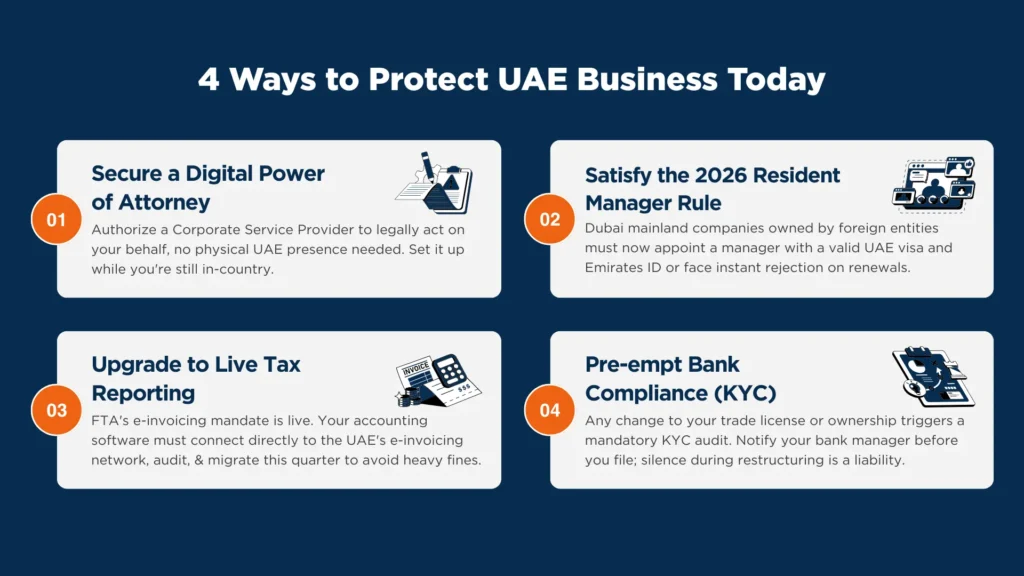
1. Secure a Digital Power of Attorney (POA)
Physical presence is no longer mandatory to keep things running. You can issue a Power of Attorney through a remote notarization. This allows a trusted Corporate Service Provider (CSP) to legally sign paperwork and protect your UAE business during uncertainty on your behalf. We act as your official hands and feet in the UAE, managing the legal red tape while you stay safely abroad.
If you are a non-resident owner, set up your digital POA right now while you are still inside the UAE. Most notaries now require non-residents to be physically present in the country just to process a remote notarization. Getting this signed today means your CSP is already legally authorized to act as your “hands and feet,” guaranteeing zero delays if you suddenly get stranded abroad.
2. Satisfy the 2026 Resident Manager Rule
If you own a Dubai mainland company through a foreign corporate entity, a major rule change took effect in February 2026. You are now required to appoint a manager who holds a valid UAE visa.
Without their Emirates ID, the system will instantly reject your incorporation or renewal paperwork.
3. Upgrade to Live Tax Reporting
The days of tallying up PDFs at the end of the year are over. To effectively protect your UAE business during uncertainty, you must comply with the Federal Tax Authority’s new live e-invoicing rollout. Your accounting software should allow live reporting of invoices to FTA each time you make one. Audit your current accounting software today to confirm it connects directly to the UAE’s e-invoicing network. Migrate to a compliant system this quarter to avoid massive FTA fines.
4. Pre-empt Bank Compliance (KYC)
Corporate banks panic during crises or sudden changes in companies. If you tweak your trade license or ownership structure, the bank will trigger a mandatory Know Your Customer (KYC) audit. Silence is dangerous. Treat your bank relationship manager like a business partner. Inform them of any structural changes before you officially submit the paperwork to the government.
Need to bring in an investor or buy out a partner to save cash flow? Learn how to do it without freezing your bank accounts in our “Crisis Guide: Add or remove a UAE Company Shareholder”.
Free Zone vs. Mainland: How Crisis Management Differs
One of the biggest mistakes overseas owners make is assuming all UAE business regulations are identical. Your continuity plan should be carefully drafted accordingly, based on where your trade license was issued.
If a global crisis grounds flights tomorrow, your recovery strategy will look very different depending on your jurisdiction.
Dubai Mainland (DET) Companies
If you operate a mainland company, you have unrestricted access to trade directly within the local UAE market. However, with that premium access comes tighter regulatory oversight.
- Stricter Local Mandates: Mainland companies must adhere to direct government updates from the Department of Economy and Tourism (DET). This includes the strict 2026 Resident Manager requirement for corporate-owned branches.
- The Physical Proxy Need: While digital tools are improving, mainland structural changes often require notarized legal documents. Having a trusted Corporate Service Provider (CSP) to act as your physical proxy under a Power of Attorney is critical for keeping the business moving.
UAE Free Zone Companies
Free zones were practically built with international, remote investors in mind. Authorities such as DMCC, IFZA, and ADGM operate their own independent jurisdictions and highly advanced digital portals.
- The Remote Advantage: If you are unable to travel due to the current situation, Free Zone setups provide a way for remote operation of business. These authorities use highly advanced digital portals, and you can manage the bulk of your corporate administration straight from your laptop. All other tasks, such as processing license renewals, updating employee visas, and executing share transfers, can all be completed online.
- Exemptions: On top of the digital convenience, Free Zone entities are largely exempt from the strict 2026 Resident Manager regulations that hit mainland firms this year. This specific exemption gives overseas investors significantly more freedom to structure their leadership teams.
The Takeaway: Whether you are in a free zone or the mainland, knowing your specific authority’s digital capabilities before a crisis hits is the only way to ensure your operations never skip a beat.
Traditional Setup vs. Crisis-Ready Setup
| Feature | The Old Way | The Crisis-Ready Approach |
| Legal Signatures | Booking flights for an in-person notary appointment. | Fully remote using a secure video-link POA and the UAE Pass. |
| Tax Reporting | End-of-year PDF manual submissions. | Live e-invoicing software linked directly to the FTA portal. |
| Local Presence | Flying back and forth to manage daily admin. | Using a CSP and a local Resident Manager. |
Moving Forward: Securing Your Business Today
Preparing your company for sudden market shifts is not about predicting the future; it is about putting practical administrative safeguards in place right now. Whether that involves securing a remote Power of Attorney before your next flight, updating your accounting systems for live tax reporting, or meeting the new 2026 mainland mandates, your time should be spent running your business, not managing corporate compliance.
Decided that running the business during this market shift is too risky? Compare your exit options in our guide: “UAE License Freezing vs. Company Liquidation”.
Your Local Corporate Partner
CorpLex seamlessly bridges the gap between digital convenience and physical compliance. Backed by over two decades of expertise in UAE business setup, legal governance, and FTA tax management, we act as a dependable local anchor for global investors. We manage the complex, on-the-ground regulatory demands so you can confidently oversee your company from anywhere in the world.
Need a trusted Corporate Service Provider to serve as your proxy and protect the UAE business during uncertainty? Contact CorpLex today to build a concrete continuity strategy that keeps your trade license active, your bank accounts secure, and your operations moving forward.
Frequently Asked Questions (FAQs)
-
How do I manage my UAE company remotely during a crisis?
You can securely manage your UAE business using a hybrid approach: using digital channels, relying on your UAE Pass to officially sign documents, and utilizing platforms like the Dubai Now app, and by teaming up with a trusted Corporate Service Provider (CSP) for reliable local representation to handle physical compliance, which is an absolute necessity to protect UAE businesses during uncertainty.
-
Can I pause my UAE trade license temporarily?
Yes. You can apply for a license freeze, or what we call a “legal pause,” of your business for up to 3 years to stop the accumulation of fines. This is much safer than simply abandoning the license and letting penalties pile up.
If you wish to know more about this legal remedy, please read: “The Strategic Guide to Freezing Your UAE Business License”. -
Do I need a local partner to own a company in 2026?
No. Currently, most commercial activities allow 100% foreign ownership. But you need to ensure you meet the local Resident Manager requirements if you are a foreign corporate owner.
-
Will my UAE corporate bank account get frozen if I am stuck overseas and my license expires?
Yes. Corporate banking in the UAE runs on strict compliance. An updated license copy and an updated Know Your Customer (KYC) should be submitted to the bank; otherwise, the automated systems will flag and freeze your accounts. You can completely bypass this risk while overseas by having a Corporate Service Provider renew your license remotely and submit the renewed license directly to your bank, guaranteeing uninterrupted access to your funds.
-
What is the biggest compliance mistake UAE business owners make during a crisis?
Allowing a license to expire or neglecting to submit a required compliance document, such as tax filings, is the biggest compliance mistake a UAE business owner makes during tough times. Running away from a UAE business or simply letting it go can lead to costly consequences.