 English

 5.0verified by TrustindexTrustindex verifies that the company has a review score above 4.5, based on reviews collected on Google over the past 12 months, qualifying it to receive the Top Rated Certificate.

Dubai International Financial Centre (DIFC) is an independent financial free zone. Established in 2004, it serves as a regional hub for the Middle East, Africa, and South Asia (MEASA). Today, DIFC is recognised as Dubai’s premier financial free zone, supporting a mix of professional services, fintech startups, and innovation-focused firms.
The Centre is governed by the DIFC Authority, which oversees businesses’ operations, growth, and licensing. Its courts follow common law and operate separately from UAE civil law, providing a system familiar to international businesses. In 2026, over 6,000 companies of all sizes operate within DIFC and benefit from flexible office plus licensing options.
Here’s how DIFC provides a cosmopolitan business environment:
Designed for companies conducting standard business operations, these entities generate revenue while limiting shareholder liability.
Structured to manage capital, assets, and succession planning:
Designed for professional teams balancing liability and operational control:
Foreign businesses can establish a DIFC presence with:
Companies must hold the appropriate DIFC license based on their activities. Many financial or regulated entities in DIFC also require a Dubai Financial Services Authority (DFSA) license, in addition to the commercial registration phase.
This regulated license is issued by the DFSA for financial firms. Categories 1-4 cover banking, investment, asset management, and advisory activities. Each category defines the services a company can provide.
Designed for non-financial services, this license applies to legal, accounting, auditing, and consulting firms. Classified as Designated Non-Financial Businesses or Professions (DNFBPs), it allows professional operations under DIFC regulations without DFSA oversight.
This license permits trading of specialized goods or services approved within the financial free zone. Companies must follow DIFC rules and operate only in activities explicitly authorized under this license.
For startups in AI, blockchain, Web3, and fintech, this license allows companies to test new products within a controlled regulatory framework. Offers coworking access and links to DIFC’s tech and investor network.
Issued for investment funds, asset management, venture capital, and corporate services. These licenses provide regulatory approval for specific sector operations and ensure companies meet all compliance and governance requirements.
DIFC permits diverse business activities across financial, professional, and corporate sectors, including:
It could reach up to $50,000, even more, depending on the company type, business activity, and number of visas to be issued. Office rent is separate and usually varies between USD 150 – 200 per sqft space. There are also serviced desk or offices available from DIFC registered business centers.
Exact costs depend on your business activity, legal structure, number of shareholders, and office requirements. Contact us for a tailored cost breakdown.
After setting up a company in DIFC, there are several mandatory post-incorporation compliance requirements the entity should follow to remain in good legal standing.
The key requirements can be listed as follows:
Common Pitfalls to Avoid:
The Dubai International Financial Centre operates under two primary authorities, DIFC Authority (DIFCA) and Dubai Financial Services Authority (DFSA). DIFCA manages company registration, commercial licensing, and district administration. SPVs and investment structures register with DIFCA but require DFSA authorization for regulated financial activities.
DFSA regulates financial activities, overseeing banks, investment funds, SPVs, and trusts. Foundations and trusts are also managed by DIFCA, with DFSA overseeing asset and trust compliance. Professional and consultancy companies are registered with DIFCA and monitored by DFSA under DNFBP rules. Choosing the correct entity ensures capital adequacy, governance, and full legal compliance.

Define Business Activity:
Identify if your business is regulated by the DFSA or non‑regulated under DIFCA, and choose an entity type accordingly.
Secure Regulatory Approvals:
Submit an expression of interest and a detailed business plan to the DFSA. This is a 4-6 month authorization process involving regulatory approvals from DIFC/DFSA.
Establish Governance and Ownership:
Appoint authorized individuals to mandatory roles, including a Senior Executive Officer and Compliance Officer, while maintaining a board with at least two directors.
Office & facility requirements:
Lease a physical registered office or flex-desk through approved DIFC providers to satisfy substance and licensing requirements.
Ensure Scalability and Compliance:
Plan for future license upgrades and ongoing obligations, including audits and AML reporting. Corplex assists firms in navigating these compliance issues.
All companies in DIFC must maintain a physical presence. Your choice of office affects daily operations, visa eligibility, and regulatory compliance. Here are common options suitable for different business sizes and activity types:
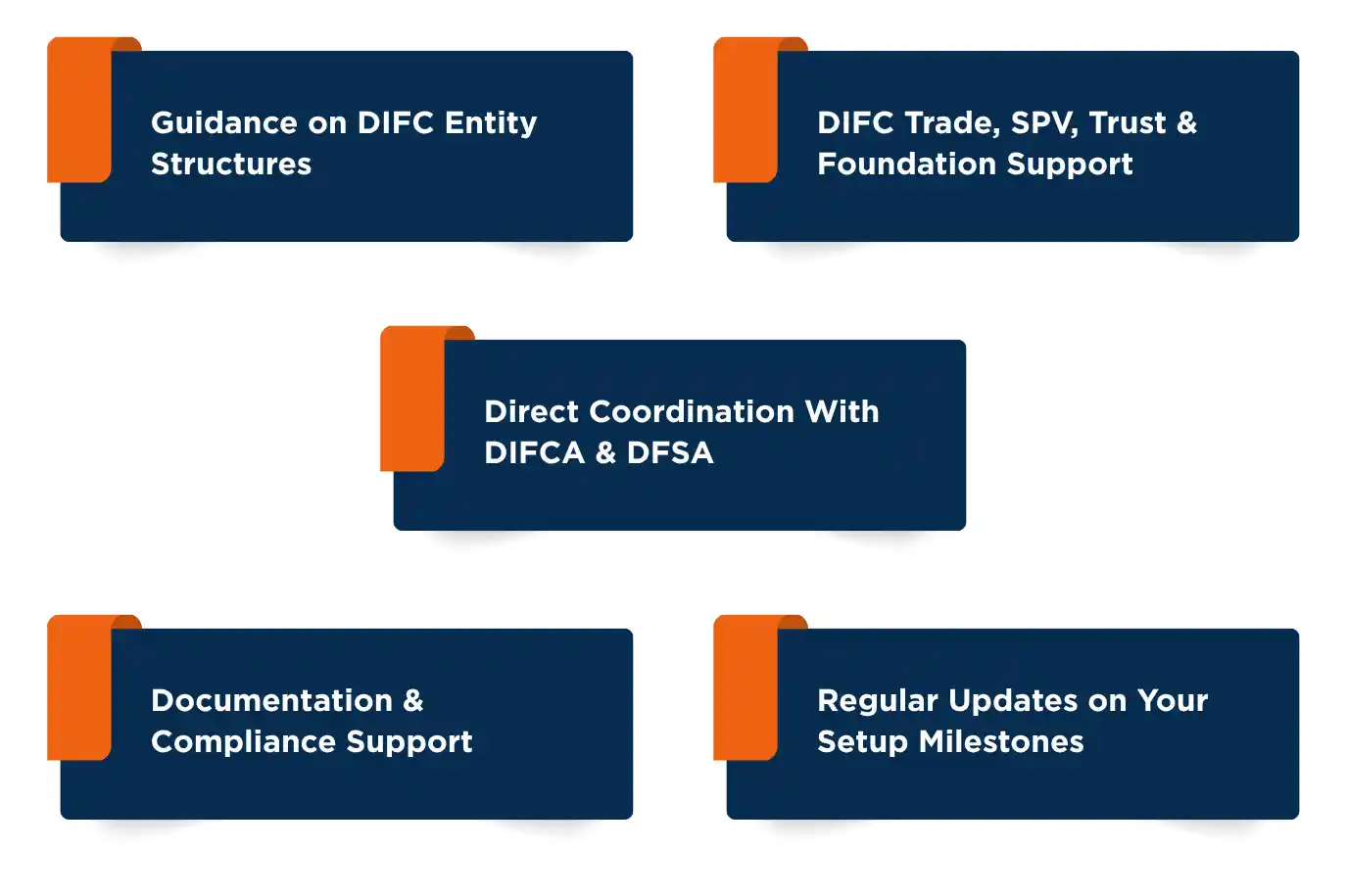
Many people struggle to set up a business in DIFC as it’s easy to make mistakes like choosing the wrong entity, not completing documents, and failing to meet compliance requirements. At CorpLex, we support your DIFC company formation with proven expertise in trade, SPV, trust, and foundation structures. Our team works directly with DIFCA and DFSA, so you can rest easy while we meet compliance and keep you updated on milestones for your DIFC setup.
Posted on Google Daler DehqonovAugust 19, 2026
Trustindex verifies that the original source of the review is Google.
We set up our company with Corplex one year ago, and the team has been truly professional, responsive, and friendly from day one. They have answered all our questions throughout the year and have also supported us with all corporate matters. Recently, they also handled the compliance request with the authority and finalized everything very quickly, while guiding us properly throughout the entire process. What we really appreciate about Corplex is that they provide end-to-end services, from company formation to visa processing corporate bank account opening, as well as tax and accounting services. A special thanks to our consultant, Rana, who has supported us endlessly and has always been available whenever we needed assistance. We would also like to thank Maylyn, Zavokhir, Nissa and the entire team for handling all our company operations so professionally. A truly reliable company with an excellent team. Highly recommended!Posted on Google Elyor Rasul-zadaAugust 14, 2026I would like to express my sincere appreciation for the excellent service and support provided throughout the visa renewal process. The entire team was very professional, responsive, and attentive at every stage. I especially appreciate how quickly you responded to our requests, kept us informed, and did your best to make the process as smooth and efficient as possible. A special thank you to Rana and the PRO team for their professionalism, patience, and dedication. Despite some unexpected challenges during the process, everything was handled in a very organized and professional manner. Thank you once again for your outstanding service and support. It was a pleasure working with your team, and I would be happy to recommend your services to others.Posted on Google
 Deepak TalwarAugust 7, 2026Posted on Google
 РусланаJuly 24, 2026I had a great experience with this company. They helped me get my visa process done so quickly and smoothly. Everything was hassle-free. Highly recommend!Posted on Google
 Helen AreguyJune 28, 2026⭐⭐⭐⭐⭐ I had a fantastic experience with CorpLex Corporate Services. They made the process of setting up my business in Dubai incredibly smooth and stress-free from start to finish. The team took the time to understand my requirements, answered all of my questions, and provided clear guidance throughout the entire process. They also introduced me to additional services that will be valuable as my business grows, including corporate tax and VAT support. Everyone was professional, friendly, and genuinely committed to making the experience as seamless as possible. I was referred to CorpLex, and I’m very grateful for the recommendation. I look forward to building a long-term partnership with the team. Thank you to everyone at CorpLex Corporate Services for your exceptional support and for making the entire process so easy. I highly recommend your services to anyone looking to establish a business in the UAE.Posted on Google
 CLAUDIO CONTIJune 26, 2026Excellent work from team of Abbosand Janine , in order of corporate tax ,very professional and knowledge of a very complex subjectPosted on Google
 Amer BinEshaqMay 21, 2026I would like to thank the team from Corplex. Especially: Rana, Ahmed & Saba. They respond very quickly, professional, and supportive. I would like to thank them also for providing clear and timely guidance. Their attention to detail, dedication, and positive attitude make working with Corplex is a real pleasure. Thank you for your outstanding support!Posted on Google
 Victoria AbeltinoApril 28, 2026I had the opportunity to intern at Corplex for 4 months and it was an incredible rewarding experience. During my time there, I learned a lot about the legal side of running a company, especially aspects related to corporate law. The internship was very well organized, and I always felt supported and guided throughout the experience. The team was extremely kind, attentive, and made sure I was actively involved, which made the experience both enjoyable and highly educational. I would also like to thank Rana Amine for their guidance and support throughout my internship. It was an incredibly valuable experience, and I genuinely loved working there.Posted on Google
 Rizwan ArshadApril 16, 2026CorpLex helped me renew my visa and setup a new company. They provided a fast and professional service keeping me informed at every stage of the process.Posted on Google
 Alisher AbdullaevApril 16, 2026Very dedicated team of professionals who will never give up for the sake of the clients’ interests 🔥
DIFC allows LTDs, PLCs, branches, LLPs, partnerships, foundations, NPIOs, regulated financial firms, non-financial companies, SPVs, & family offices across multiple sectors.
Yes, foreign investors can form DIFC SPVs or Foundations with 100% ownership. Reach out to Corplex for end-to-end support.
All entities need DIFC registration; financial firms require DFSA approval, capital, and approved officers.
SPVs take weeks, non-regulated entities 4-8 weeks, and regulated firms months. Corplex reduces delays through accurate documents, proactive follow-ups, and planning.
Yes, DIFC entities can redomicile to free zones or the mainland. Corplex can help with approvals, NOCs, and overall business continuity and transitions.
WhatsApp us
